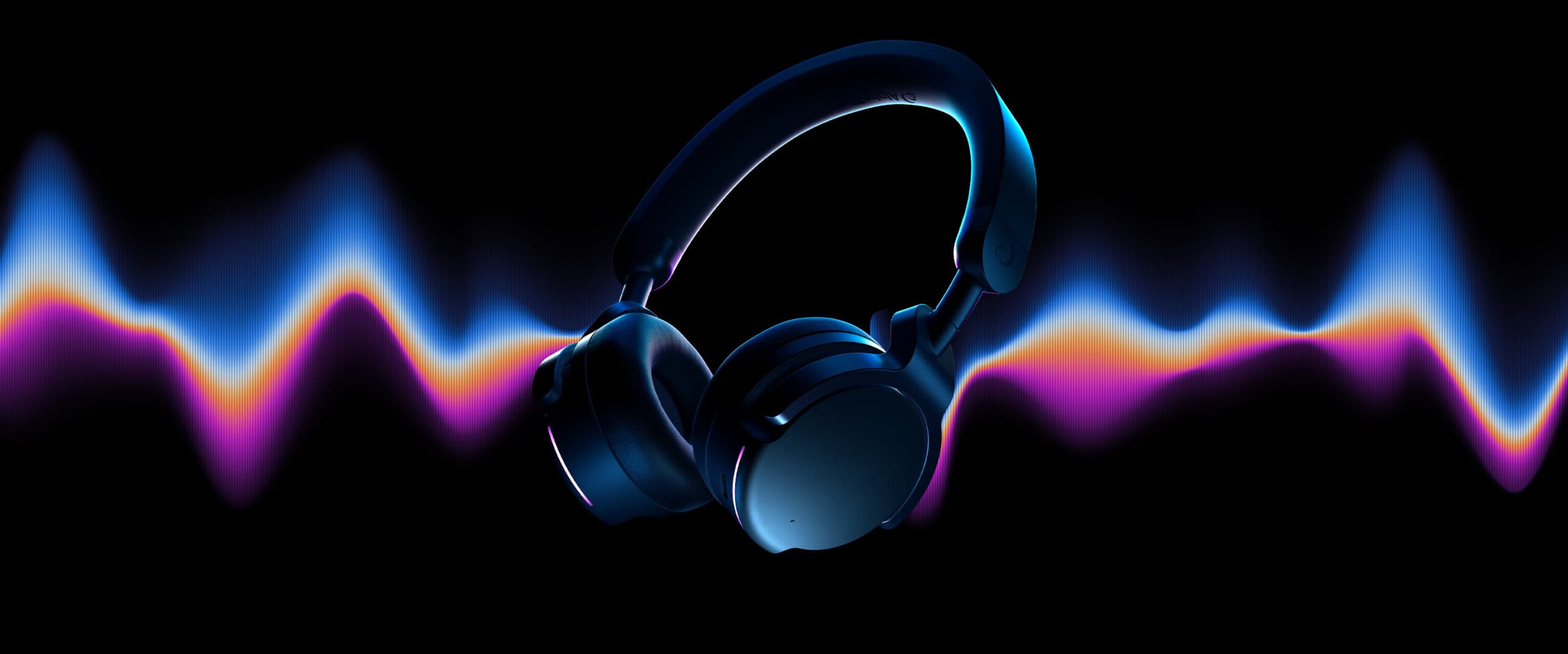
Every DJ has done the dance. You step back to hype the room, check a request, or reach for a record, and the headphone cable reminds you exactly how far you are allowed to go. AlphaTheta announced the HDJ-F9 on October 15, according to The FADER, and the pitch is simple: cut that cord without losing the cue. The HDJ-F9 is a professional on-ear wireless DJ headphone built around SonicLink, AlphaTheta's own low-latency wireless technology, arriving in late October for $349, per The FADER and EDMTunes.
That is a serious claim, and it deserves a serious test — not on a spec sheet, but in the booth, on a long night, on a mixer you did not bring. Here is what the numbers actually say, what the price tag leaves out, and who should be first in line.
Why 9 Milliseconds Is the Whole Argument
Latency is the reason DJs have stayed wired while everyone else went wireless. Any delay between what you hear in your headphones and what comes out of the speakers turns beatmatching into guesswork. SonicLink keeps that delay as low as 9 milliseconds, according to AlphaTheta and The FADER — low enough, AlphaTheta says, to monitor a mix and even scratch without a cable.
Context matters here. DJ TechTools notes that sound travels about three meters, roughly ten feet, in 9 milliseconds, so on paper the delay is about what you would hear from a booth monitor a few steps away. The same piece puts typical Bluetooth delay on these headphones at 200 to 300 milliseconds, using AlphaTheta's own numbers — fine for a podcast, far too slow for cueing. That gap is the entire product. Bluetooth 5.3 is on board for everyday listening, per AlphaTheta's specifications, but SonicLink is the mode that has to earn its place in a working rig.
One caution before you retire your cable: DJ TechTools flags that 9 milliseconds is an ideal-conditions figure for a 2.4 GHz link, in rooms full of phones and wireless microphones competing for the same air. Treat the number as a best case to verify in your own booth, not a guarantee for every room.
The Part the Price Tag Leaves Out
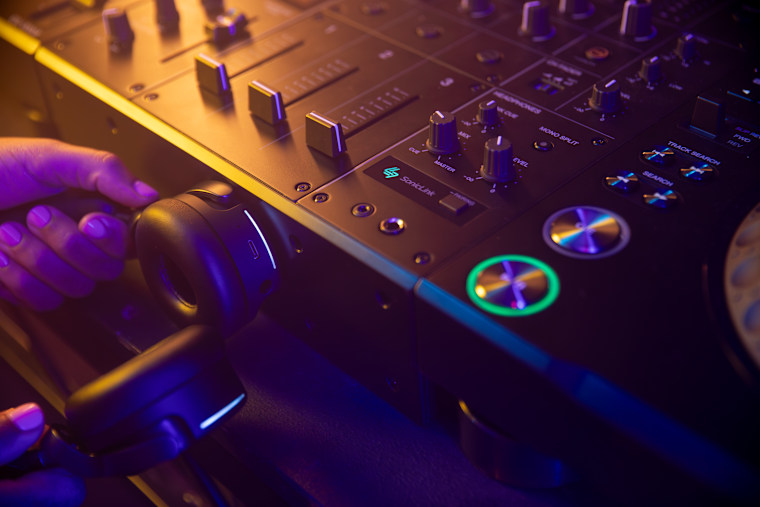
The $349 headline only tells half the story. The HDJ-F9 introduces SonicLink Touch Pairing: touch the headphones to compatible gear and they connect, starting with AlphaTheta's DJM-V5 mixer, which needs a firmware update first, according to The FADER and AlphaTheta. If the booth is not running that mixer, you need the separately sold SonicLink Transmitter HP-TX01 to go wireless at all.
That transmitter changes the math. AlphaTheta lists the HP-TX01 at $159 in the United States, and DJ TechTools does the addition most DJs will do at the counter: $349 plus $159 is $508 total for wireless cueing on the HDJ-F9. DJ TechTools also makes the point working DJs cannot ignore — most booths do not have SonicLink. Outside a DJM-V5, you are bringing the transmitter to every gig, plugging it into the house mixer, and keeping two batteries charged instead of one.
None of that kills the idea. It just moves the HDJ-F9 out of impulse-buy territory and into rig-planning territory. If you control your own setup — residents, mobile DJs, and DJs who travel with their own mixer — the transmitter is a one-time addition to the bag. If you walk into a different house rig every weekend, the cable in the box starts to look less like a backup and more like the plan.
Battery, Weight, and the Long Night Test
On paper, the night math works. With the status LED on, the battery lasts about seven hours over SonicLink and 13 hours over Bluetooth, according to AlphaTheta and The FADER. Turn the LED off and those figures rise to nine hours and 25 hours. A full charge takes approximately 2.5 hours, and a 30-minute charge gives around 2.5 hours of use, per AlphaTheta. SonicLink range is approximately 15 meters in unobstructed locations, per AlphaTheta's specifications — more than enough to work a booth, not a license to wander the dance floor.
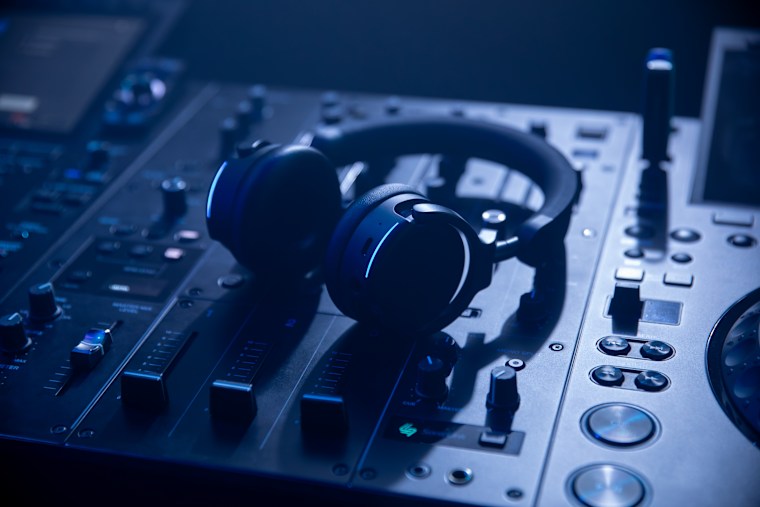
The fit should suit DJs raised on on-ear booth staples. The HDJ-F9 uses newly developed 40 mm drivers with a bass-reflex chamber in each housing and weighs 285 grams, according to The FADER and AlphaTheta. DJ TechTools puts that in context: the HDJ-F9 is the second SonicLink pair after the over-ear HDJ-F10 from October 2024, it weighs less than the F10's 356 grams, and AlphaTheta does not list active noise cancelling on the F9 spec sheet, unlike the F10. What you get instead is passive isolation, swivel hangers for one-ear monitoring, and — critically — a coiled cable in the box for wired monitoring, per AlphaTheta. When the battery dies mid-set, the night does not.
There is one more launch detail to plan around. The HEADPHONES CONNECT app, which customizes the status LED color and brightness and delivers firmware updates, is Android-only at launch, with the iOS version scheduled for a later date, according to DJ TechTools and AlphaTheta. iPhone DJs can still play on day one, but they should expect to wait for the full app experience.
Who Should Actually Buy These — and Who Should Wait
Buy early if you are a resident or mobile DJ who plays the same rig most nights, hates the cable dance, and will actually use the freedom to move, host, and read the room away from the decks. The on-ear weight, the nine-hour LED-off SonicLink figure, and the wired fallback make the HDJ-F9 the most practical wireless cueing option AlphaTheta has put at this price.
Wait if your weekends are guest spots on house gear you do not control. Until more booths carry SonicLink built in, you are paying $508 for a wireless system you have to install yourself at every load-in, then testing a 2.4 GHz link in a room you have never played. That may still be worth it — but it is a decision to make with your gig calendar in front of you, not from a product video.
Either way, the direction is clear. Wireless cueing is no longer a gimmick looking for a problem. The HDJ-F9 makes the strongest case yet that the cable is optional — as long as you budget for the transmitter, charge like a professional, and keep that coiled cable in the bag where it belongs.
Filed under The Booth, MixShow Prime's DJ-world desk.